Why Smart Traders Are Shorting Right Now and How You Can Too
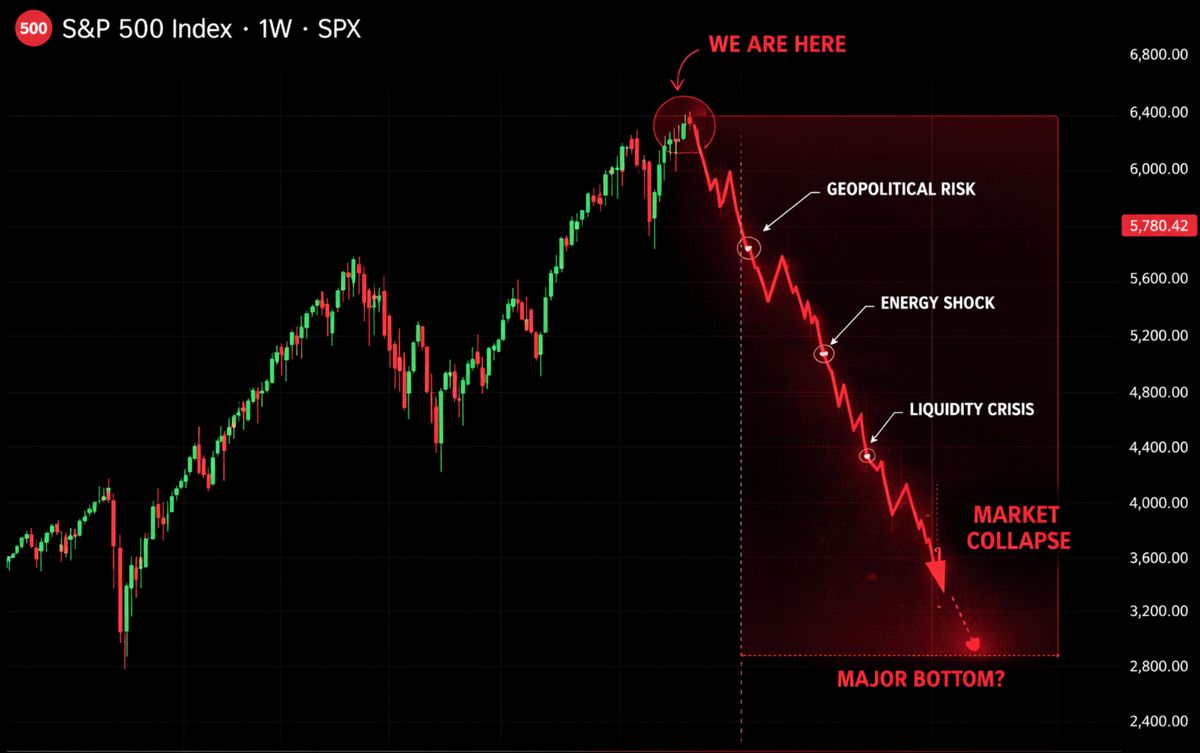
I am going to be straight with you. What I am seeing right now across global markets is something I have only seen a handful of times in over a decade of trading. And every single time these signals lined up before, the people who were paying attention made serious money. The people who were not? They got crushed.
The S&P 500 is cracking. Oil just blew past $100 a barrel. Japan is quietly pulling the rug on global liquidity. And most people are still scrolling through their feeds completely oblivious to what is about to unfold.
This is not fear mongering. This is pattern recognition. And if you understand how to position yourself on the short side of the market, the next few months could be the most profitable window you have seen in years.
Let me break down exactly what is happening and what I am doing about it.
The S&P 500 Is Already Breaking Down
Look at the chart. The S&P 500 hit its all time high near 7,000 and has been rolling over hard. As of this week, the index closed around 6,830 after its worst week of 2026. That is a 2% drop in five days, with $800 billion wiped from market capitalisation in a single session.
But here is what the mainstream financial media is not telling you.
According to The Street's analysis, roughly 38% of stocks in the S&P 500 are already in a bear market. That means they are down 20% or more from their highs. And about 65% are in correction territory, meaning they have dropped at least 10%.
The index itself looks like it is holding up because a handful of mega cap tech stocks are masking the damage underneath. But beneath the surface, the majority of the market is already in serious trouble.
Goldman Sachs' top strategist warned this week that stocks are flashing the same warning signs as the Great Financial Crisis. That is not some random analyst on Twitter. That is Goldman Sachs.
When I see this kind of divergence between the headline index and the actual health of the market, I know exactly what comes next. The headline number catches up to reality. And it catches up fast.
Oil at $100 Changes Everything
The Iran conflict escalated significantly this week. U.S. and Iranian tensions are at levels we have not seen in years, and the market is pricing in the very real possibility that the Strait of Hormuz could be disrupted.
For context, roughly 20% of the world's oil supply passes through that narrow corridor. If that flow gets interrupted, even partially, the consequences ripple through every single market on the planet.
Oil has already spiked 12% in a single week according to Reuters, pushing past the $100 per barrel mark that Bloomberg confirmed on March 8. This is not a slow grind higher. This is a shock.
Here is why this matters for every asset class you own.
When oil spikes, it increases costs across the entire economy. Transport, manufacturing, food production, logistics. Everything gets more expensive. That reignites inflation, which is the one thing central banks were desperately trying to kill.
If inflation comes roaring back, the Federal Reserve cannot cut rates. They might even have to raise them. That means tighter monetary conditions, less liquidity, and a direct hit to stock valuations.
History backs this up completely. The oil shock of 1973 triggered a brutal bear market. The Gulf War spike in 1990 sent equities tumbling. The commodity surge before the 2008 financial crisis was one of the final catalysts that broke the system.
We are watching the same playbook unfold right now. And betting markets have already increased the probability of a U.S. recession in 2026 to 33%.
Japan: The Liquidity Time Bomb Nobody Is Watching
This is the one that most people are completely missing. And it might be the most dangerous of all.
Japan holds $1.2 trillion in U.S. Treasury bonds. That makes them the single largest foreign creditor to the United States. For decades, Japan kept interest rates at essentially zero through a policy called yield curve control. That system pushed massive amounts of Japanese capital into global markets, including U.S. stocks, bonds, and risk assets.
That system is now unwinding.
The Bank of Japan abandoned yield curve control, and Japanese government bond yields have roughly doubled. The 10 year JGB yield has climbed to 2.17%, and the 20 year is sitting at 3.5%. That might not sound dramatic, but in a country that had near zero yields for decades, this is a seismic shift.
According to the American Enterprise Institute, this creates a very real risk of capital repatriation. As Japanese bond yields become more competitive, Japanese investors have less reason to keep their money in U.S. assets. They start pulling capital home.
And then there is the carry trade. For years, traders borrowed cheaply in yen and invested in higher yielding assets globally. As the yen strengthens and Japanese yields rise, that trade unwinds. Citi's research team warned that JPY carry trades are "structurally built into the global market" and that an unwinding would cause "far faster and stronger currency appreciation than currently expected."
When carry trades unwind, they do not do it slowly. They snap. Liquidity gets pulled from every corner of the market simultaneously. Stocks, crypto, commodities, everything correlated to risk gets hit.
This is happening right now. Not in six months. Right now.
The Structural Problem: A Decade of Fake Liquidity
Here is the bigger picture that ties all of this together.
For the past decade, markets have been propped up by extraordinary monetary policy. Near zero interest rates, trillions in quantitative easing, central banks buying assets hand over fist. That environment pushed valuations to levels that have no connection to underlying fundamentals.
Stocks, crypto, real estate. Everything went up because money was cheap and abundant. Not because the economy was genuinely strong.
Now that liquidity is being pulled from multiple directions at once. The Fed is not easing. Japan is tightening. Oil is forcing inflation higher. The U.S. jobs market just posted a negative NFP print, raising genuine concerns about economic weakness.
When you have geopolitical tension, energy shocks, rising global yields, and capital retreating from foreign markets all happening simultaneously, you do not get a gentle correction. You get a repricing event.
The traders who understand this are already positioned. The ones who do not are about to learn an expensive lesson.
What I Am Doing About It
I have been trading markets for over a decade. I was ranked the number one copy trader in the world on Bitget, and I have trained over 50,000 people through MTC Education to read exactly these kinds of setups.
Right now, my approach is clear. I am looking for short opportunities across multiple asset classes. When the macro picture is this bearish, you do not fight the trend. You ride it.
On Bitget, you can open short positions on Bitcoin, Ethereum, and dozens of other assets using futures contracts. This means you profit when prices go down. And with the correlation between crypto and traditional risk assets being as tight as it is right now, a major equity selloff will drag crypto down with it.
Here is how I approach it:
Identify the setup. When you see the S&P 500 breaking key support levels, oil spiking, and bond yields rising simultaneously, that is your macro confirmation. The trend is down.
Pick your entries. I do not chase. I wait for rallies into resistance and short the bounces. The market will give you pullbacks. Use them.
Manage your risk. This is where 90% of traders fail. Every position needs a stop loss. Every trade needs a defined risk. I never risk more than 1 to 2% of my account on any single trade. If you want to learn how I structure my risk management framework, I have written extensively about it.
Stay patient. Bear markets do not move in a straight line. There will be violent bounces that shake out weak hands. If your thesis is sound and your risk is managed, you hold your position and let the trade work.
Why Bitget Is My Platform of Choice
I am not going to pretend this is not a recommendation. It is. I have used Bitget for years and it is the platform I trust with my own capital.
Here is why. Bitget gives you access to futures trading on hundreds of pairs with deep liquidity. The execution is fast. The fees are competitive. And if you sign up through my exclusive partnership link, you get fee discounts, access to free airdrops, and early token access that is not available to regular users.
If you are serious about trading the short side of this market, you need a platform that can handle the volatility. Bitget is built for exactly that.
I have done a full Bitget review if you want the detailed breakdown.
The Window Is Now
Let me be real with you. I have been doing this long enough to know that the biggest opportunities come when the majority of people are scared or confused. Right now, most retail traders are still holding long positions hoping for a bounce. They are watching their portfolios bleed and telling themselves it will come back.
Some of them will be right eventually. Markets always recover. But the question is how much pain they are willing to sit through before that happens. And whether they have any capital left when it does.
The smart money is not waiting. They are positioning now. They are reading the same data I just showed you and they are acting on it.
If you want to learn how to trade these conditions properly, join the trading signals channel where I post real time analysis and setups. Or if you want the full education, MTC Education will teach you everything from reading charts to managing risk to executing with discipline.
The market does not care about your feelings. It rewards preparation. And right now, the prepared traders are the ones going short.
Frequently Asked Questions
Why are traders shorting the S&P 500 right now?
Multiple converging risks are creating the perfect storm for short sellers. The Iran conflict has pushed oil above $100 per barrel. Japan's rising bond yields are threatening global liquidity as capital gets repatriated. The U.S. just posted a negative jobs report. And beneath the headline index, 38% of S&P 500 stocks are already in bear market territory. When this many risk factors align simultaneously, experienced traders position for further downside.
How does oil at $100 per barrel affect the stock market?
Oil above $100 increases costs across the entire economy. Transport, manufacturing, and food production all become more expensive. This reignites inflation, which forces central banks to keep interest rates higher for longer or even raise them. Tighter monetary conditions reduce liquidity, which historically leads to equity corrections or outright bear markets. The 1973 oil shock, 1990 Gulf War, and 2008 commodity surge all followed this exact pattern.
What is the Japan carry trade and why does it matter?
For decades, Japan maintained near zero interest rates, which encouraged traders to borrow cheaply in yen and invest in higher yielding assets globally. This created a massive source of liquidity for stocks, bonds, and crypto worldwide. As Japanese bond yields rise and the yen strengthens, that trade unwinds. Capital gets pulled back to Japan, stripping liquidity from global markets. Citi has warned that this unwinding could happen "far faster and stronger" than most expect.
Can you short the stock market using crypto exchanges like Bitget?
Yes. Platforms like Bitget offer futures contracts on Bitcoin, Ethereum, and dozens of other assets. Because crypto is highly correlated with traditional risk assets right now, a major equity selloff typically drags crypto down with it. By opening short positions on Bitget, you can profit from declining prices. Michael Sloggett has been ranked the number one copy trader on Bitget and uses the platform for his own trading.
Is this a good time to start learning to trade?
Volatile markets create the biggest opportunities for educated traders. The key word is educated. If you jump in without understanding risk management, position sizing, and market structure, you will get destroyed. Through MTC Education, Michael Sloggett has trained over 50,000 people to read these exact setups and execute with discipline. Whether the market goes up or down, a skilled trader can profit. But you need the skills first.